

How to Play Jaipur: Rules, Setup and Winning Strategy (2026 Guide)

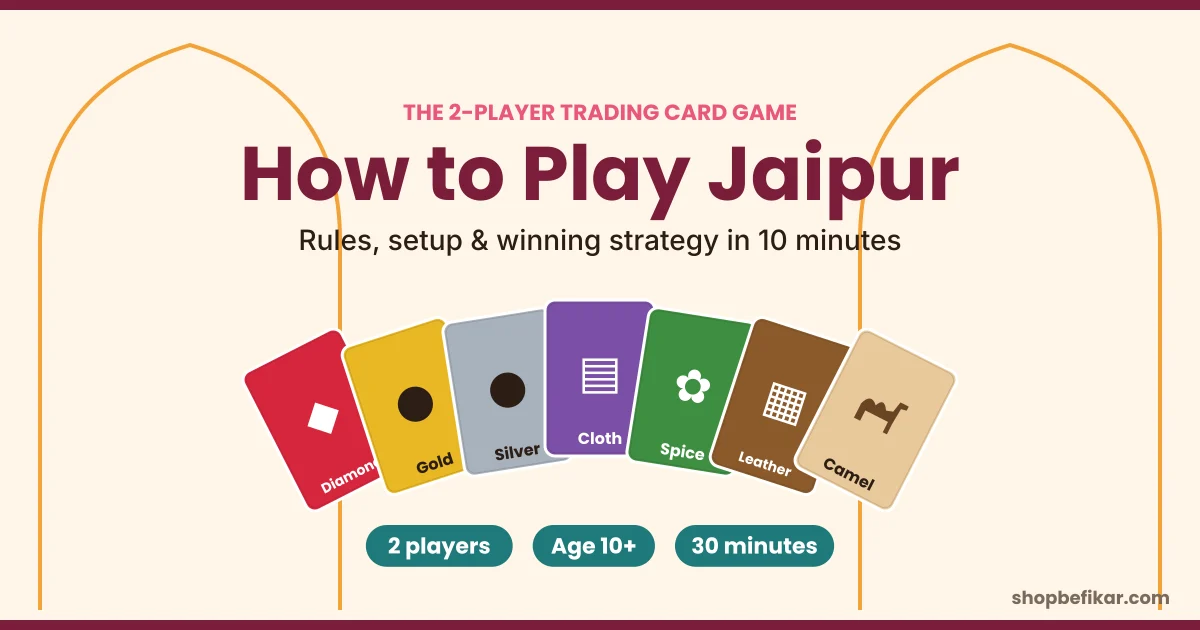
Jaipur is a fast 2-player trading card game: you buy and sell goods in the markets of Rajasthan, and the first trader to win 2 Seals of Excellence wins. This guide teaches you the full rules in about 10 minutes, with setup photos, scoring examples and tips to beat your partner on your next game night.
Jaipur at a glance
| Detail | Jaipur |
|---|---|
| Players | 2 |
| Age | 10+ |
| Play time | About 30 minutes |
| Type | Trading and set-collection card game |
| Designer | Sébastien Pauchon |
| Difficulty | Easy to learn, tricky to master |
| Best for | Couples, siblings, friends, travel |
New to Jaipur? It is one of the best 2-player board games you can buy, and you can get the original Jaipur game on Shopbefikar with fast delivery across India.
What’s in the box
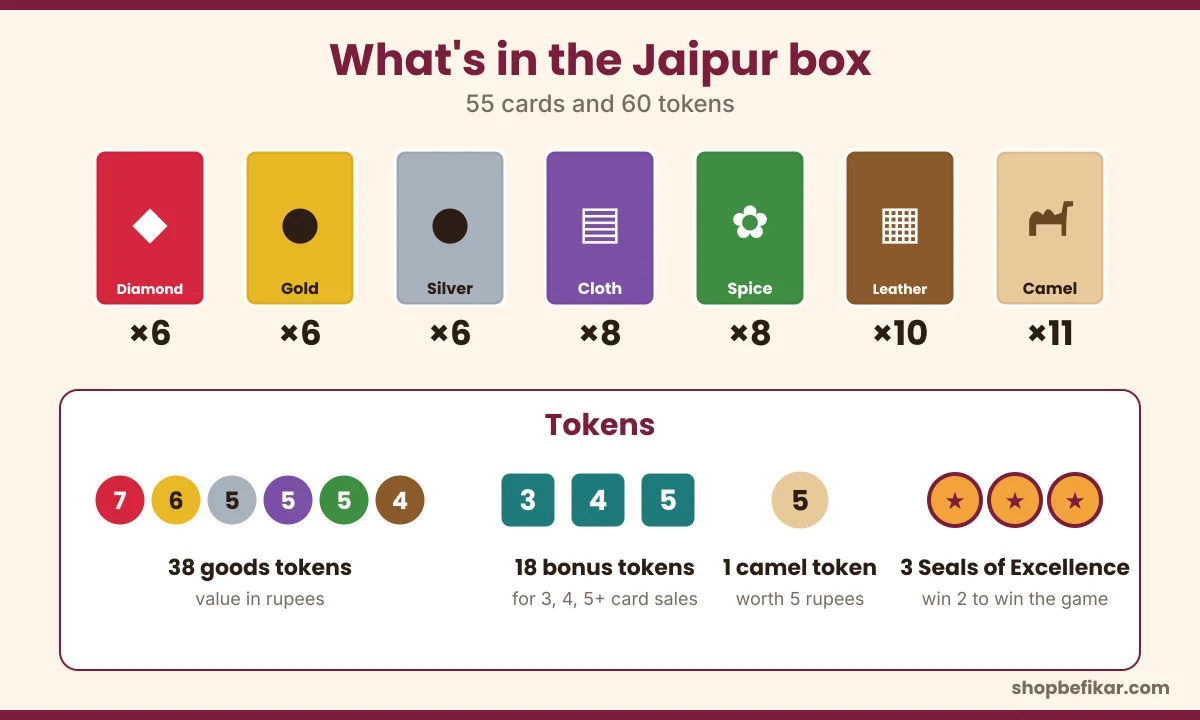
| Component | Quantity |
|---|---|
| Goods cards: diamonds, gold, silver | 6 each |
| Goods cards: cloth, spice | 8 each |
| Goods cards: leather | 10 |
| Camel cards | 11 |
| Goods tokens | 38 |
| Bonus tokens (3, 4 and 5-card sales) | 18 |
| Camel token (worth 5 rupees) | 1 |
| Seals of Excellence | 3 |
The goal is simple: be the richer trader at the end of a round to win a Seal of Excellence. The first player with 2 seals wins the game.
How to set up Jaipur
Setup takes under 2 minutes. Follow these steps in order.
- Build the market. Place 3 camel cards face up in a row between the two players.
- Deal hands. Shuffle the rest of the cards and deal 5 to each player. The remaining cards form the face-down draw pile.
- Finish the market. Turn the top 2 cards of the draw pile face up next to the camels. The market now has 5 cards.
- Make your herd. Each player takes any camels out of their hand and places them face up in front of them. This is your herd. Camels never stay in your hand.
- Lay out the goods tokens. Sort tokens by goods type and stack each type with the highest value on top. Fan them out so both players can see every value.
- Prepare bonus tokens. Shuffle the 3-card, 4-card and 5-card bonus tokens separately and make 3 face-down piles.
- Place the rest. Put the camel token beside the bonus piles and the 3 Seals of Excellence within reach.
- Pick a starting player. You are ready to trade.
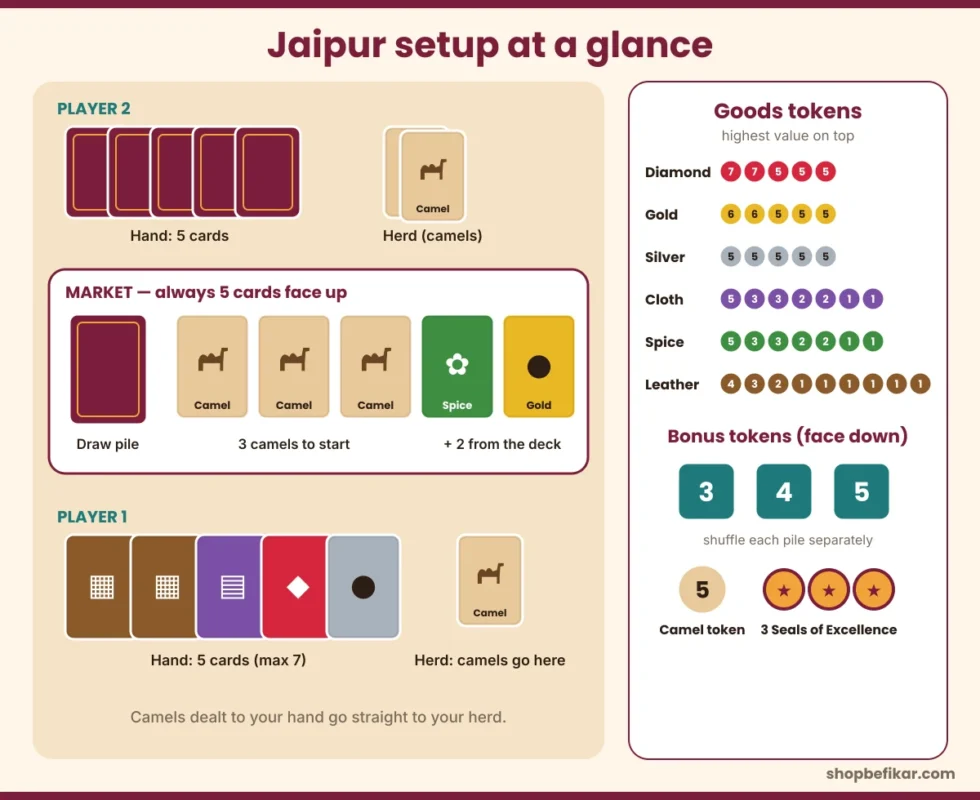
Tip: Leave space between the token stacks. Players check token values on almost every turn, so a tidy layout speeds up the game.
How a turn works
On your turn you do exactly one thing: take cards or sell cards, never both. Then your opponent plays.
Option 1: Take cards
Choose one of these three ways to take cards from the market.
- Take one good. Pick a single goods card from the market. Refill the empty spot from the draw pile.
- Take several goods (exchange). Take 2 or more goods from the market and put back the same number of cards from your hand, your herd, or both.
- Take all the camels. Take every camel in the market into your herd, then refill the market from the draw pile.
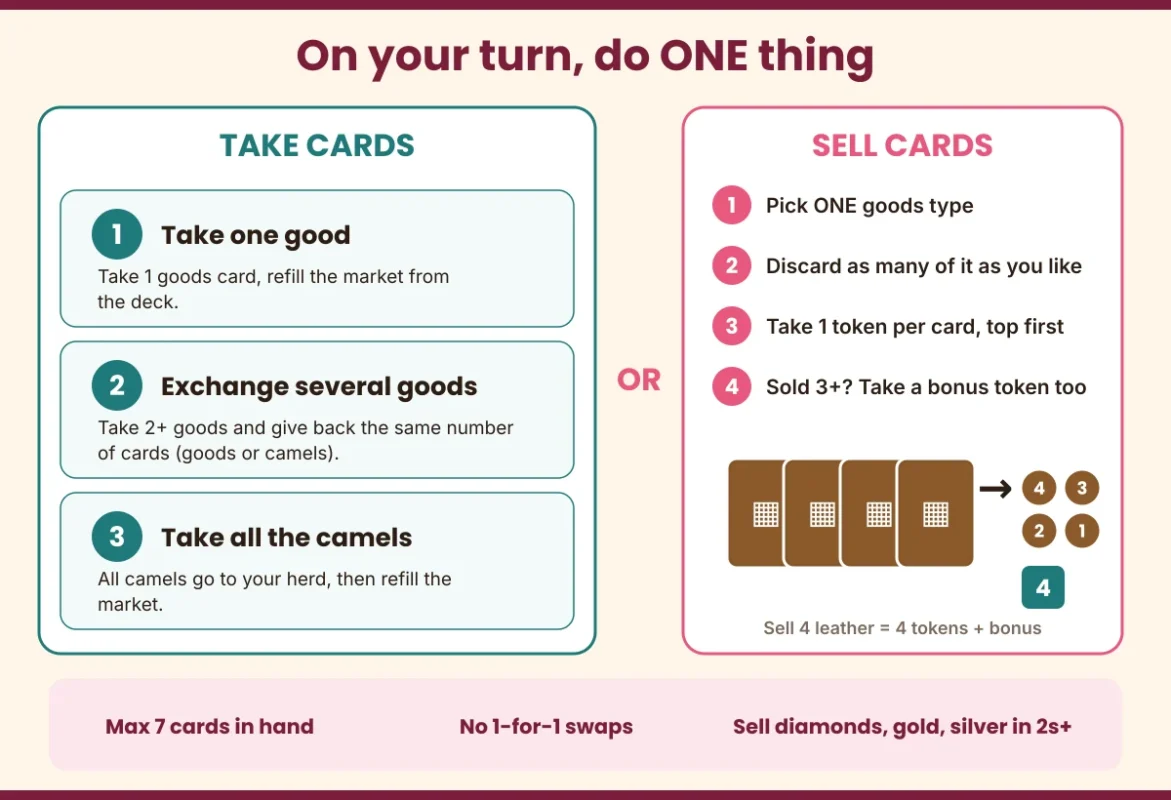
Three rules trip up new players:
- Hand limit of 7. You can never end your turn with more than 7 cards in hand. Camels in your herd don’t count.
- No 1-for-1 swaps. An exchange is always at least 2 cards for 2 cards.
- No same-type swaps. You can’t give back and take the same type of good in one exchange.
Option 2: Sell cards
- Choose one goods type and discard as many cards of that type as you like.
- Take one goods token of that type for each card sold, always from the top of the stack (highest value first).
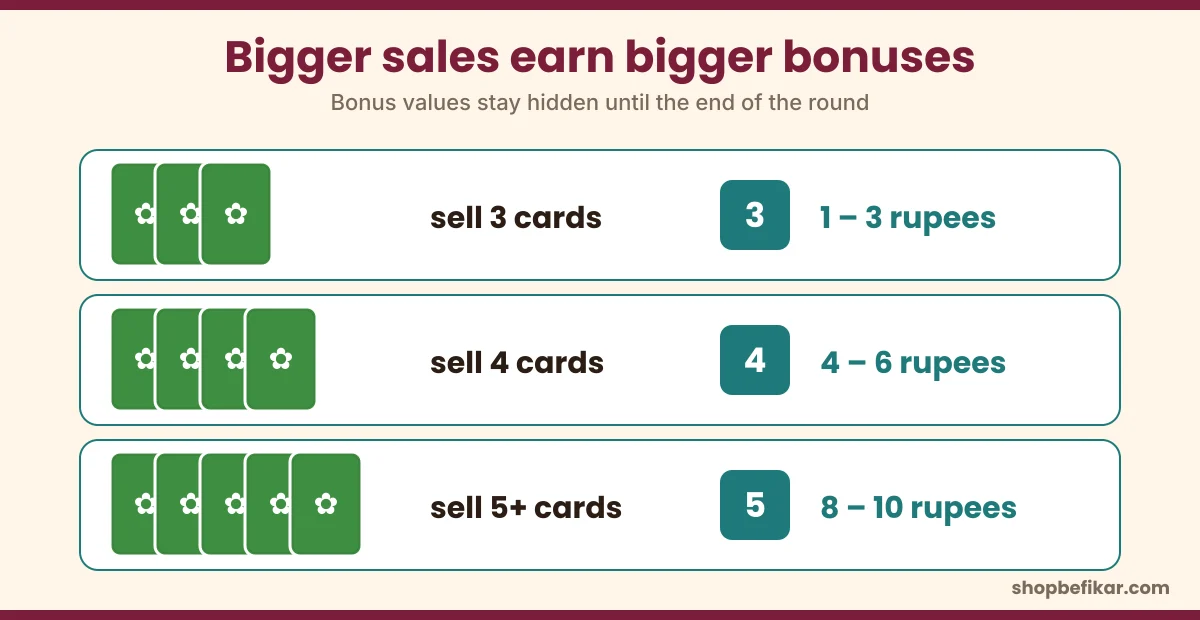
- If you sold 3 or more cards, also take a bonus token of the matching size.
Diamonds, gold and silver are precious goods. You must sell at least 2 of them at a time, even if only one token is left.
Bonus tokens
Bigger sales earn bigger bonuses. The value is hidden on the back until the end of the round.
| Cards sold at once | Bonus token value |
|---|---|
| 3 cards | 1, 2 or 3 rupees |
| 4 cards | 4, 5 or 6 rupees |
| 5 or more cards | 8, 9 or 10 rupees |
End of round, scoring and winning
A round ends immediately when either:
- 3 types of goods tokens have run out, or
- the draw pile is empty and the market can’t be refilled.
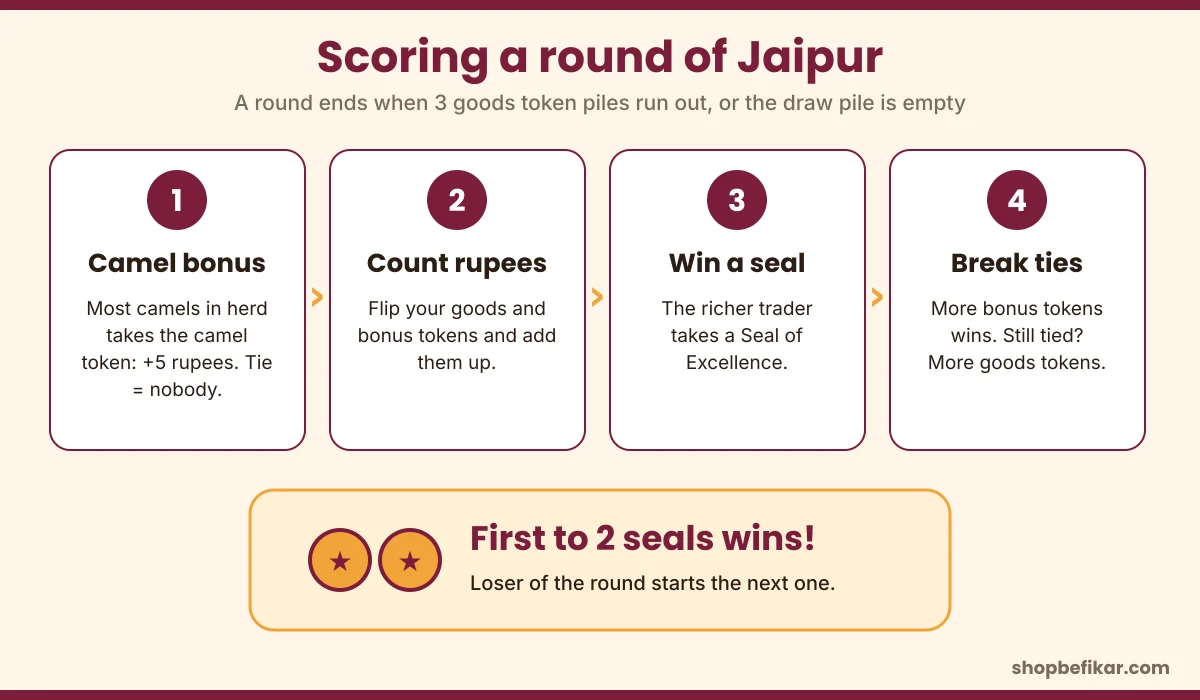
How to score a round
- Camel bonus. The player with more camels in their herd takes the camel token, worth 5 rupees. If camels are tied, nobody takes it.
- Count your rupees. Both players flip their goods and bonus tokens and add up the values.
- Award the seal. The richer trader wins a Seal of Excellence.
- Break ties. If rupees are tied, the player with more bonus tokens wins the seal. Still tied? The player with more goods tokens wins it.
Example
Priya ends the round with 58 rupees of goods and bonus tokens and 4 camels. Arjun has 55 rupees and 6 camels. Arjun takes the 5-rupee camel token, so he finishes on 60 rupees and wins the seal.
Winning the game
If nobody has 2 seals yet, set up again and play another round. The player who lost the last round goes first. The game ends the moment a player earns their second Seal of Excellence. That player becomes the Maharaja’s personal trader.
7 strategy tips to win at Jaipur
- Sell cheap goods early. Leather, spice and cloth tokens drop in value fast. The first seller gets the best tokens.
- Hold out for bonus tokens. Selling 5 cards can earn you up to 10 extra rupees. Wait for a big set when the token values are still high.
- Use camels as currency. Camels let you grab 2 or 3 goods in one exchange without breaking up your hand.
- Think before taking all the camels. The market refills with fresh cards from the deck, often handing your opponent a great turn.
- Watch the camel majority. The 5-rupee camel token decides many close rounds. Count both herds before the round ends.
- Track the token stacks. When 2 goods types are sold out, the next sold-out type ends the round. Sell what you have before it’s too late.
- Deny your opponent. Sometimes the best move is taking the card they clearly need.
Common mistakes new players make
- Keeping camels in hand. They always go straight to your herd.
- Selling only 1 diamond, gold or silver card. Precious goods need at least 2.
- Selling two goods types in one turn. It’s one type per sale.
- Forgetting the hand limit of 7 after an exchange.
- Swapping 1 card for 1 card. Exchanges are 2 cards or more.
Jaipur FAQ
Is Jaipur only for 2 players? Yes. Jaipur is designed only for 2 players, which makes it a favourite game for couples and siblings.
What age is Jaipur suitable for? The box says 10+. Younger kids who are confident with simple addition can often play with a little help.
How long does a game of Jaipur take? About 30 minutes for a full game of 2 to 3 rounds.
Can you sell just one card in Jaipur? Yes, for leather, spice and cloth. Diamonds, gold and silver need at least 2 cards per sale.
Do camels count toward the hand limit? No. Camels live in your herd, and only cards in your hand count toward the limit of 7.
What happens if camels are tied at the end of a round? Neither player takes the camel token.
Who starts the next round? The player who lost the previous round.
Ready to play Jaipur?
Buy Jaipur on Shopbefikar — the original game, fast delivery across India, free shipping on orders above Rs. 499.
More games you’ll love if you like Jaipur
- 7 Wonders Duel — the most popular 2-player strategy game; build a civilisation in 30 minutes.
- Splendor Duel — gem trading and set collection, a natural next step after Jaipur.
- Sky Team — a 2-player co-op game: land the plane together.
- Codenames Duet — the hit word game, made for 2.
- The Mind — a quick, wordless co-op card game that works brilliantly with 2.
- Arkham Horror: The Card Game — a deeper story-driven game for 1 to 2 players.
Browse more: all board games · card games · family games
Next guide: How to Play The Mind (coming soon ).